Sunday, November 6, 2011

2011 Net Impact Conference

"If we don't change our direction, we're going to end up where we're going."

With this Chinese proverb we began the 2011 Net Impact Conference in Portland, Oregon.  This annual conference aims to energize attendees to promote social and environmental good through business.  Over 2,600 participants from schools and industry met to discuss the latest ideas in clean tech, social entrepreneurship, impact investing, international development, and corporate responsibility.

Lord Michael Hastings addresses the Portland Ballroom

Business cannot succeed in a world that fails.  But business is not the enemy – it rather is the most powerful potential force for improving social cohesion and environmental stewardship.  Successful businesses improve the human condition.  Businesses can be profitable and meet the needs of the present without diminishing the ability of future generations to meet their needs.  This will happen when profits are aligned with the interests of society and the planet.

The conference showcased ways that businesses are achieving this alignment.  It kicked off last Thursday with a keynote address by Lord Michael Hastings, Global Head of Citizenship and Diversity at KPMG.  He stressed that the key to change is overcoming cynicism.  Friday started with Liz Maw, Executive Director of Net Impact, asking participants to "occupy Wall Street from the inside".  Sally Jewell, CEO of REI, emphasized that there is "no mission without margin" and talked about efforts of Walmart and others to develop a consumer-facing eco index.
FedEx, EDF, and Eaton talk about partnerships
Breakout sessions followed and I looked to branch out beyond all the renewable energy panels that I listened to at the 2010 conference.  One of the best I listened to featured leaders from FedEx and Environmental Defense Fund talking about how they partnered with Eaton to develop a fleet of hybrid electric vehicles that have trimmed FedEx's fuel costs and lowered greenhouse gas emissions.  I also listened to a panel of educators debate the merits of charter schools and the impediments to improving productivity in public education.  My day finished with a riveting group of cleantech VC's talking about the factors they consider when investing in green economy companies.


In the middle of all this was an expo featuring companies interested in hiring students who want to use their talents to promote social and environmental good.  Considering that I met Waste Management at the conference twelve months ago, I know from experience that the expo can connect students with great companies.  This year, I also spoke with representatives from Eaton, Sprint, PG&E, Gazelle, and Mercy Corps.

Saturday was a lighter day but still featured several good speakers.  A group of entrepreneurs delivered "speed keynotes" in the morning.  Jen Boulden asserted that "green business is not an oxymoron, like jumbo shrimp" and told us that we needed to escape "paralysis by analysis" when starting our ventures.  Darell Hammond spoke about the urgency he felt to build playgrounds in urban areas.  Vail Horton presented his inspiring story of starting a business despite not having any working arms or legs.  I then attended a session presented by a pair of career consultants, who spoke about strategies for finding that dream job.  Seeing some rare Portland sunshine, I rented one of the free bicycles provided by the conference to explore a little of the city's riverfront and downtown.  The conference ended with a keynote by Hannah Jones, VP of Sustainable Business and Innovation at Nike, who presented a frank discussion of 12 years at a company that was once a "poster child for all that is wrong with supply chains".  She spoke how Nike has managed to innovate and change its approach, and closed with some advice: "Don't measure yourself by the competition – measure yourself by the potential."

Quick bicycle tour of downtown Portland
Much like last year, I came away from this year's conference with a much fuller picture of the challenges in joining people, planet, and profit, but also with a hopeful sense of the possibilities.  I enjoyed reconnecting with folks outside of my Darden network and meeting new faces with change on their minds.

The industrial revolution style of doing business simply won't work through the 21st century.  The strains it presents to our ecosystems and our social fabric are simply too great.  I'm impressed that 2,600 participants came together to discuss "sustainable business" in Portland, but I'm hoping that I reach a point in my business career where this becomes the de facto way of building an enterprise.  The urgency is great – if we stagnate with current business practices, if we don't change direction, then where we're going could be a dreadful place.  But I remain optimistic that we can innovate to sustain all 7 billion people on our planet.

Thursday, October 27, 2011

Hokie Heaven vs Wahoo-Wa

My sister Jillian and me
Last Saturday I received an invitation from my sister to attend a football game at Virginia Tech, where she is an undergraduate.  I gladly accepted and made the 2.5 hour drive from Charlottesville to Blacksburg, happy to catch up with my sister and seeking to gain a greater understanding of the UVA-VT school rivalry.

I will say that attending a business school with a big-time football team is pretty cool, especially as I didn’t have a real football team to take pride in during my undergraduate university experience (more on that later).  Internationals tend to find it odd that American universities even have glorified sports teams at all.  These teams are a source of pride for students and alumni and date back to the late 19th century.  American football and men’s basketball are by far the two most popular with spectators; unfortunately UVA has struggled at both of late.  You can think of the passion surrounding a big college football game as being comparable to a raucous soccer stadium abroad.

Having attended a Tech and a UVA game on successive October weekends, let’s compare the two experiences on several important dimensions…

Tailgate: Big edge VT
I arrived in Blacksburg at 11AM for a 3PM kickoff, and when I met my sister she was already frantic to get out of her apartment so we could join the tailgate frenzy.  Get this – fans of VT are out tailgating 5 or 6 hours before game time!  Each group grilling in the parking lot seemed to have a Virginia Tech tent and the bean bag game “cornhole”.  My sister’s tailgate at Tech had a delightful spread: grilled burgers, brats, pizza, chips & guacamole, shrimp salad, broccoli salad, assorted fruits and vegetables, rye crackers, potato chips, and some exceptional jalapeno peppers stuffed with cheese and wrapped in bacon.  I washed this down with a couple beers and several “dark and stormies” (a cocktail consisting of rum and ginger beer).  And after the game we did even more tailgating – I've never done that anywhere before!
The Darden tailgates before UVA home games are good as well, but simply can’t compare to the exceptional tailgate experience at Tech.  Darden generally has barbeque (pulled pork, potato salad, cole slaw, burgers) or some spread from Chick-fil-A and keg beer, but the tailgates only begin 2 hours before game time and can become too crowded to navigate when corporate recruiters are in town.
Fans: Big edge VT
UVA students storm field after unexpected football upset
Even before I arrived at the stadium I knew who the winner would be on this dimension, based on all the vehicles I saw on the highway covered in VT stickers and flags.  At Tech, everyone is in the stands before kickoff, and the stadium is full.  Everyone is in Tech gear – thankfully my sister had a sweatshirt I could borrow so I could fit in.  The stadium is LOUD – students stand the entire game and scream on almost every play when the defense is on the field.  Third down plays are a bit obnoxious – students rattle their keys (because it’s a “key play”) and the disgusting sound of a turkey gobbling plays on the stadium speakers – but certainly intimidating for the opposing team.
UVA, on the other hand, is what I will term nicely a “wine and cheese” crowd.  The fans are relatively sedentary compared to the Tech fanatics and certainly don’t rush to get to the game on time.  The dress code is confusing – some fans wear orange, others wear the more traditional ties and sundresses (weird Southern tradition), and the remainder don’t even dress up at all.  I’ve never seen Scott Stadium at capacity, either.  But the UVA students did rush the field after an unexpected win against a highly regarded opponent two weeks ago, which was pretty cool to watch.
Band: Tie
Both the Cavalier and Hokie marching bands are loud and enthusiastic.  Each amplifies the spirit in the stadium.  Both bands dance around endlessly in the stands and get me revved up.
Halftime Entertainment: edge UVA
Well I already compared the bands, but UVA gets the edge here for its talented baton twirlers.  At the last game I saw one juggling 3 batons simultaneously, each lit on fire!  Simply awesome.
Song: big edge UVA
UVA’s fans are definitely the more musical of the two.  The “Good Old Song” that plays after each touchdown does cheer hearts and join hands, as the lyrics go.  And I like the “Wahoo-Wa” cheer, though it’s difficult for most Darden students to learn.  Students at Tech, on the other hand, don’t even know their school song…pathetic.
Cheerleaders: definite edge VT
UVA’s cheerleaders can barely form a human pyramid.  Tech’s were quite skilled.
Team Quality: definite edge VT
Tech has had a far better football team than UVA for years – it has won the last 7 games between the two teams and 11 of the last 12.  Tech perennially receives invitations to top post-season bowl games while UVA football players are stuck at home.  And I’ve seen some wretched UVA football team performances in front of the home crowd during my two years of business school.  But perhaps there is hope…UVA was the #1 ranked football team for a brief period in 1990 and had successful teams throughout the 1990s.
Mascot: definite edge UVA
This guy rocks!
The Hokie is an ugly, turkey-like bird.  Not ferocious at all.  Surely Tech could have picked a better one.  UVA’s CavMan, on the other hand, is fierce and good-looking.  The human embodiment of the Cavalier rides into the stadium on horseback prior to kickoff waving a sword…one of my favorite parts of any UVA football game.
Stadium Aesthetics: edge UVA
Scott Stadium is beautiful – fellow blogger Patrick Clifton once described it as having a "a gladiatorial, amphitheatre feel."  The symmetric horseshoe wrapping around the field is completed by a lawn area for students.  Tech’s Lane Stadium is an intimidating concrete jungle and not pretty at all.
Overall: After judging on nine dimensions, the VT and UVA football experiences have fought to a tie with 4 wins each.  But UVA is simply the best – I now have a special place in my heart for Mr. Jefferson’s university, and Tech will always be the “enemy”.  Plus, Tech doesn’t have a top-tier business school like UVA does!
Speaking of which, let’s see how Darden compares to top 10 U.S. business schools (as judged by the Poets & Quants aggregate ranking) in terms of football quality, in case that is an important consideration for deciding where to apply!

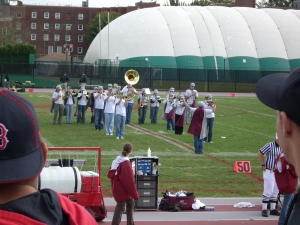
This is the MIT marching band in "pi formation"...I kid you not
·        Harvard: This school’s biggest game every year is against Yale.  Most of my friends that are alumni of these two schools tell me that people mostly don’t even end up in the stadium for the football, but rather drink in the parking lot.  Way to support your team, guys.  Kudos to Harvard though for having Ryan Fitzpatrick graduate to the NFL.
·        Wharton: Penn has a mediocre team – I don’t think anyone watches them
·        Tuck: Same as Wharton
·        Columbia: Even worse than Penn or Dartmouth.  And the players wear baby blue jerseys.
·        Stanford: A top 10 ranked team this year, but the school’s mascot is a dancing tree.  If your mascot is a dancing tree then I have a hard time taking your football team seriously.
·        Haas: Cal has a good team, a big rivalry with Stanford, and my all-time favorite quarterback (Aaron Rodgers) played for them several years ago.  I approve.
·        Fuqua: Awful, awful, awful football team.  But if you love getting psycho about men’s basketball then Duke is a great place to go.
·        Kellogg: Northwestern’s football team is typically the doormat of its conference, and the team wears a not-so-ferocious purple jersey.
·        Booth: I didn't know Chicago had a football team until I looked it up. 
·        Sloan: I can confirm from my undergraduate experience at MIT that the football team is pathetic (I had roommates on the team).  The football “stadium” would be embarrassing for most American high schools and the stands always had more supporters for the away team than for the Engineers.  The mascot is a goofy-looking grinning beaver and the “band” consists of about 5 amateur geeks looking for an excuse to blow their trumpets outdoors.
So there you have it – clearly, only Haas and Darden can offer top-notch MBA and football experiences.  Go Wahoos!!!

Wednesday, October 19, 2011

Blink...and there goes First Quarter!!

Last year, in the midst of the depths of Black November, my learning team survived our GEM case discussions by watching this parodic South Park clip about the global financial crisis...


After watching this again (and getting another good laugh) I think that this video sums up my second year of business school, in a way. Instead of a bank account I have a rapidly dwindling account of time. These days, it feels like I blink my eyes, click my heels, and two weeks passes by. Annndd it's gone!

"What do you mean? I have a whole year left!"
"Not anymore you don't. Poof!!"
"Well what can I do to get back my..."
"I'm sorry sir, but this school is for enrolled students only."

This (or something similar) has been a recurring nightmare for me and many of my classmates over the course of the second year. Life at business school is way too fulfilling to want to leave and reenter the real world (though a paycheck would be nice). Probably every MBA graduate that I have spoken to in the universe has talked about how the second year passes far too quickly and how you need to make the most of the precious few moments we have here. Unless I'm able to complete my prototype time machine soon, we all will need to heed this advice.

29 mile bike ride to benefit the
Central Virginia Boys & Girls Club
I'm a little incredulous that I haven't written in this blog since August. Between a packed class schedule, student club events, nights on the town, intramural sports, weekends away, days in the mountains, and the full-time job search, I've known that I wanted to write something but just didn't commit the hour or two to piece together a proper blog entry.

Well, let's start at the beginning then. The second years returned to Charlottesville around August 20 or thereabouts. The first week or two was definitely a "honeymoon" period -- everyone was absolutely thrilled to be back and to see all the classmates who they had missed over the summer. Sort of like how the beginning of first year was defined by making introductions and getting to know everyone, the beginning of second year was marked by everyone wanted to know what you did with your summer and whether you liked it. We all talked about how things would be different (and better) in our second B-school go-round.

And different second year has been, though like the other bloggers I don't find that it has been any less busy. There have been weeks where my Outlook calendar has looked as ridiculous as Sara Sajadi's, though not nearly as well color-coordinated. The busy character of second year is far more manageable than first year -- it really is a "choose your own adventure" as fellow blogger Lily mentions. We all have our interests and the freedom to pursue them. For me this has involved planning events for the Energy Club as well as checking off items from that Charlottesville bucket list we all have.

Another beautiful day on Darden grounds
One of the aspects that I've found really valuable from my second year experience thus far has been the ability to use my "wisdom" built up from a year at Darden to mentor and advise the incoming student class. I was selected this year to serve in the Second Year Coaches program, where I am able to help 4 first-year students navigate the turbulent waters of MBA internship recruiting. This has been a great opportunity for me to give back to the school, as I was particularly grateful for the advice my SY Coach provided me last year. I have a great group of FY's to work with and I enjoy helping them find themselves anyway I can.

After a couple weeks all of us second years found our "flow" and are quite settled in now that it's October already. I do miss my mates in Section E but like that I'm able to see some new faces in the classroom through SY electives. The intensity level in class isn't the same as FY but there still are some really engaging case discussions. My Q1 tax class was probably the hardest class that I have taken at Darden and Horniman's "Leading Strategic Change" provided moments I was laughing so hard that my diaphragm hurt. Also, in elective classes you get some great guest speakers -- the hostage negotiator that visited my Bargaining class was definitely one of my top 5 class periods at Darden!

Time to get back to making every moment count between now and the seven months to graduation. So long until next time!

Wahoo-wa!  UVA football game

Darden Oktoberfest...PROST!

Rock slide in Shenandoah N.P.

Thursday, August 25, 2011

Darden FY Day with Habitat for Humanity

Hello everyone! I returned to Charlottesville last week and it is glorious!! The life of a second-year in business school is sweet indeed!

No time for rest with me as I was immediately thrust back into the swing of things. This year I've joined fellow blogger Lily West on the Darden Outreach Committee, where I will be helping to coordinate Darden's involvement with our community neighbors. We have an ambitious agenda this year, including a canned food drive, tutoring at local schools, and a fund-raising dance marathon!!


Last week was orientation week for the incoming First Years. This year Darden introduced a new Outreach Day at the end of the week on Saturday for interested FY volunteers to break away from school and contribute to the C'Ville community. Students were able to participate in activities with the SPCA, the Blue Ridge Area Food Bank, and with Habitat for Humanity.

I took charge of the Habitat effort and am proud to report it was a great success! We had two shifts of roughly 40 students each putting up dry wall and siding on a multi-family community of homes. I'm especially proud of the students who made it out for the early (8AM) shift after a late Friday night of partying! The crew leaders with Habitat were grateful for the assistance and impressed with what the FY students were able to accomplish.

This new group of students is definitely service-oriented and off to a great start in school. You can see all the pictures from the day here. Welcome Darden Class of 2013!


Thursday, August 11, 2011

Summer Learnings

As the summer internship winds down and Report Out Day has past, a time of reflection is upon me. Trapped inside by the Houston summer heat (under a heat advisory for the entire month of August thus far), I sit at my computer to ponder the insights I've gained over my 11 weeks here.

My summer at Waste Management has been a tremendous learning experience and I am delighted that I had the opportunity to work there. I have connected with a great network of colleagues and MBA intern peers, and I am grateful at the level of responsibility and access that WM entrusted in its interns this summer. I certainly recommend the WM Organic Growth Group to any incoming first-years considering an internship next summer.

With that overview in mind, I give you all a list of key learnings from my summer. Several may sound trite, but certainly these are meaningful to me.

1. At a public company, the shareholders are the boss
Of course this is obvious, but the meaning didn't sink in for me until recently. Before business school I had worked at a private company without any outside investors, so I knew exactly who I was ultimately answerable to -- his office was down the hall.

In the weeks leading up to WM's 2nd quarter earnings announcement on July 28th, I knew things weren't looking too rosy. Discretionary costs such as travel were being pared back and I had heard about a hiring freeze, but those who had been around for awhile said this wasn't cause for concern. Then, three days before the earnings release, I learned that my summer mentor had been laid off, along with several other employees at corporate. Earnings were dismal as I suspected, 5 cents/share below Street estimates, and WM's stock was pounded (as I write this, it is down 20% from when I started my internship -- which hopefully won't be held against me when managers consider a full-time offer!).

Since I joined WM, its stock (blue line) has had its butt kicked by both the S&P 500 (green line) and arch rival Republic Services (red line)

Now I had seen people terminated at my pre-B-school job, but never any of my close peers or people above me. Having my mentor Greg laid off hit my morale -- hard. I had lost the person I could bounce ideas off of for my summer projects, or ask questions about interpreting old analysis that didn't quite make sense. I had lost the person who set up intern lunches with all the managing directors that touch our group, and the person who made sure I was actually being paid. I just felt...loss.

Such is life at the big corporation, I realize. The layoffs felt reactive...unnecessary in better times. But when shareholders demand costs come down, the big corporation needs to respond.

CEO David Steiner talks about the difficulty in managing today's business while simultaneously investing in the future. Some investors don't care about the future, or don't believe in his story about why the company needs to change. I wonder how much these future investments played a role in missing the earnings estimate.

2. Corporate America can be very tribal
Even at a company of 70 employees, like my last job, cliques develop and managers develop favorites. That said, everyone pretty much knows everyone, and interacting with the entire organization isn't all that difficult.

At a 43,000 person company, of course, one couldn't possibly know everyone. One couldn't even know the 900-odd people at corporate. That said, I'm surprised by the extent to which people cling to small clans at a big company.

Take the 44th floor, for example. Next to the Organic Growth folks you have Corporate Communications. Down the hall are folks in Customer Experience and Marketing. These four kingdoms all seem to act independently, held together in a loose union by a common break room and air conditioning. Perhaps this is my fault, but I haven't even spoken with half the folks on my floor, probably. Off my floor this stat is far worse -- I have only been to floor 45 for the vending machine, and haven't even walked on floors 42, 46, or 47...all WM.

In analyzing this, I suppose that part of the reason could be that our projects rarely overlap. I associate strongly with those I work with, but as an intern I haven't generally been comfortable introducing myself to those who I don't. And I think this is the culture at WM. I hope that as a full-time employee I would act differently.

End of my ride-along on a truck, pulling in to the scale at the Atascocita Landfill

3. Enforcing culture from the top is a struggle
I sense a near universal disdain at WM for Human Resources. I think people's gears get ground partly by the prolonged orientation days and the ever-present reminders about how to spell G.R.E.E.N. (Great operations, Respected brand, Empowered employees, Engaged customers, Neighbors of each other and our environment -- it's on my screen saver!). I see the struggle -- managing a big battleship of an organization and trying to steer it to be a high-performing operation by delivering messages to people who generally want to be free thinkers and not told what to do.

At my old company, culture was rarely discussed, which was both good and bad -- a high-performing company evolved over time, but analysts sometimes felt overworked with a lack of purpose. The approach of the big corporation feels somewhat "1984"-ish at first, but perhaps I would grow accustomed to this messaging over time.

4. At a large company, the information you need is usually somewhere internal -- unlocking the gatekeeper can be a big challenge
During intern HR orientation (everyone's favorite!), we played a game in which your team needed to cross a vicious desert to reach a mining village, with the goal to bring as much gold home as possible. Your team could ask an old man for advice, but your team would lose time for hiking and mining, and the old man might prove unreliable. Turned out that the old man knew his stuff.

For almost every project I've needed information on this summer, there's usually an "old man" at WM (not literally, of course) with the wisdom to guide me to an answer. However, accessing this information is not always easy. Sometimes I wouldn't know that information was available internally, or sometimes I wouldn't know who in a particular group to contact. I discovered that people outside one's tribe can become very busy and difficult to get a hold of. These communication differences were often magnified by the large distances between people, sometimes across the country even. And sometimes information would be withheld, as the gatekeeper feared the information may be used against him.

I'm not sure how WM could improve its information sharing, but certainly reaching folks in the big corporation was not nearly as easy as in my old job.

5. Public exposure can be cool...except when it's not
A nice thing about working at a big company is that people outside the company know what you do. Well, they probably don't know what YOU do, specifically, but you probably don't need to explain what your company does to them. In my old job, explaining what a power trading company did and why it was valuable for society was a big challenge!

The WM Organic Growth Group explores all sorts of cutting-edge investments into new waste conversion technologies, some of which have really cool potential (in my humble opinion). The group was even profiled in the December 2010 issue of Fortune magazine (see my March posting). However, with that exposure means all sorts of used-car salesman coming to WM with crackpot ideas on how they can turn waste into gold. I've needed to screen several, which has been fun...or not!

I'd never worked before for a company that could buy space for its logo on a stadium scoreboard

6. Some companies DO value work-life balance
A BIG positive from my summer. Leaving in the evening by 6PM has been lovely, and I've put in a fairly pathetic effort in trying to fill all of those extra hours in my day. I still remember the days at my old job of sometimes trying to sneak out at 5:45 to catch friends for happy hour downtown -- people definitely took notice there. At Waste Management, on the other hand, the seemingly early departure is strongly encouraged. Definitely a plus.

7. I'm still young
Surrounded by a pool of recent college graduates at my old company, it was easy to forget that I remain a recent entry into the job market. Working in the company of "grown-ups" at WM has pleasantly reassured me that 28 is still a young age and that a life of career potential awaits!

*************************

Well, that's a wrap on my summer. Time to pack up my car again and head back to Charlottesville!

Wednesday, June 29, 2011

Lunch with David Steiner, Waste Management CEO

From left: Chris, Daniel, Nimisha, David Steiner, Meredith, Stephanie, and me

Last Monday I was privileged to have the honor of dining with David Steiner, CEO of Waste Management. The Strategy and Organic Growth MBA interns met David in the "Parlor" room, the fancy-pants corner suite in corporate headquarters connecting the CEO's office with the Board of Directors' conference room. Swank digs indeed! Over a catered lunch from Lenny's Sub Shop, the local sandwich place in the basement of First City Tower, we picked David's mind to learn his thoughts about the future trajectory of Waste Management's business.

First, though, David was the one asking us the questions, an excellent strategy for buying himself time to eat his sub. He wanted to know how we thought about his company's branding, going as far as to suggest that the name "Waste Management" may not accurately represent its business. For a company looking to ride at the front of the sustainability train, Steiner may have a point. David believes that in 10-20 years a big transformation will have happened in the waste industry, that we will actually be mining landfills for raw materials. He thinks that Waste Management could eventually pay consumers for their garbage if investments in technologies pan out that can convert wastes to chemicals and fuels. David wants to put his competition out of business through his investments in these new innovations.

David told us his story about becoming CEO, which was somewhat unusual as he entered neither as a "company lifer" nor as a "celebrity boss". Rather, Steiner entered Waste Management in 2000 as deputy general counsel, a time when WM was reeling in the wake of an accounting fraud scandal and shareholder lawsuits. These lawsuits gave David visibility with the Board of Directors, which relied on his opinions to help dig WM out of its problems. Subsequently, Steiner was promoted to Chief Financial Officer in 2003 despite repeatedly being told by Board members during the interview process that he was "unqualified". David actually had a speech prepared to the Board for if he didn't receive the position, and was almost completely unprepared for when he did! A year later he became the most visible person in the company.

David shared with us his advice for aspiring CEO's of the future. Though talent is important, he said, timing also plays a crucial role in moving ahead with your career. Therefore, you must put yourself in situations where you are given visibility and asked for your opinion by superiors so that you will be considered for promotion when opportunity strikes. If you're not in such a position in your career, he said, then it's time to find another one.

Also, David believes that one can broadly categorize those in corporate America into two types: those who do as they are told, and those who ask "Why?". David firmly believes that businesspeople should aspire for careers where they can ask this latter question.

Finally we talked about the challenges of being CEO, as one would have little visibility into the role until one is actually in it (or very close). CEO is a 24/7 job, says Steiner. A CEO needs to avoid the "Godfather" dilemma -- the virtues of a corporate structure (established decision-makers, ability to manage distant operations, steady cash flows) are constantly met by roadblocks to information by lieutenants who don't tell the CEO everything. In fact, the CEO can't possibly know everything about the business; he just doesn't have enough time to research for himself. Therefore, Steiner said, it's vital as CEO get people you trust around you.

For Waste Management specifically, Steiner is challenged by getting people to believe the vision of his business's transformation from a company which hauls trash to a landfill to one which gives waste materials new life. Shifting the course of the "battleship", as David likes to refer to his company, isn't easy.  Steiner talks frequently with other CEOs who have managed transformations and is good friends with the CEO of Best Buy, an American electronics mega-retailer which managed to change itself from a high-volume outlet to a premium high-service store. Because of his focus on the future, Steiner doesn't like managing quarterly earnings, and speaks primarily to the 40% of investors he believes will stay with the company for the long-term.

Overall, I came away very impressed with David and his leadership of Waste Management. David is highly personable and could tell stories about the business for hours. I think storytelling ability is a trait which associates itself with all of the CEOs I have listened to since beginning at Darden. Also, I find that CEOs possess incredible energy for their grueling jobs. CEO's aren't superhuman -- they put on their pants one leg at a time just like the rest of us -- but they do all seem to be powered by nuclear energy. With endless meetings and pieces of information flying around these individuals are able to stay engaged and maintain their roles as face of the company. I don't quite know how they pull it off, but I realize that if I don't find this zest for a career that I will never rise to the top.

Monday, June 20, 2011

Houston and the Summer Internship

After my memorable Darden trip to Israel following the end of classes, I sadly had little time to linger around Charlottesville before packing my clothes into my car for the 1200 mile trek to Houston, Texas. I have been here for three weeks already -- time flies here just like at Darden -- so it's time to give an update and reflect a little.

They weren't lying about the summer heat on the Gulf Coast of Texas...it has been wicked hot here since I arrived in Houston. The average high temperature so far this month has been 98 degrees F!! I've dealt with summer heat before but never this relentlessly and my comfort zone, calibrated by many temperate summers growing up in the northern US, is being seriously stretched. I pray to the gods every day to keep my air conditioning in working condition...so far so good!


I've never lived in Texas before and I've heard from "real" Texans that Houston doesn't provide one with a proper introduction to this unique state, but certainly there are many differences to the style of living here compared with other places I've lived. My first impressions of Houston weren't great. I've never encountered a more car-dependent city, and I've never seen so many strip malls or tinted car windows. Houston is sprawling and super flat. The concrete and asphalt on its six-lane "Texas-sized" highways seem to extend forever. Way too many pickup trucks here, almost exclusively a lifestyle statement as few people are hauling anything -- there aren't any cattle ranches here anymore. The lack of zoning sprinkles nice neighborhoods next to dodgy ones, and the downtown is mostly a dead zone after work hours. I miss beautiful Charlottesville's rolling hills, its trees, and its starry nights.

The Greenopolis "Dream Machine"
Many of the native Houstonians I've encountered look at me as some odd foreigner who needs his head checked. "You don't have any family here?" "You're not a student at Rice?" My car is still the only one with Virginia plates which I've seen since arriving. "Austin is way cooler." I was a little shocked by the negativity with which these locals regard their hometown. I'm a non-oil guy in an oil town, which I suppose does make me an odd breed.

However, as I've started to make my way around town I have seen the good side of Houston too. The people here tend to be friendly and unhurried, a stark contrast from the DC-area and most of the Northeast US. The city is remarkably diverse, even more so than Washington DC in my opinion. In Houston you will find a melting pot of immigrants recently arrived from Asia and Latin America, and you can eat just about any type of cuisine found under the sun (the dumpling places downtown are particularly tasty). In a big city there is always something to do or a new hot spot to visit. And people tell me that winter is pretty pleasant here!

Though my verdict on Houston thus far is mixed, I have had a good experience at Waste Management thus far. There's now a lot more that you can do with garbage besides incinerate it or dump it in a landfill, and I'm excited by the investments that WM is pursuing to prepare for the future of its business. I'm interning in the Organic Growth Group, which serves as a business development arm for the business, and see the work as almost like working at a venture capital group. Globally, the biomass conversion area of renewable energy is booming right now with activity, and I'm developing a far greater appreciation as I work up a steep learning curve at WM. My coworkers, most with MBAs themselves, are intelligent and pleasant to work with. They have welcomed the interns almost like family, which I have greatly appreciated.

Corporate America is a new experience for me too. Working at the headquarters of a Fortune 500 company has a far different feel than a 70-person energy trading company. I zoom up an express elevator every morning to the 44th floor and make sure my name badge is clipped on my belt. So far our managers have kept us interns to strictly 40-hour weeks. Leave at 5:30??? Whoa! I actually can have a life in the evenings now!

So, in spite of the weather, no regrets in coming to Houston for the summer. I have greatly enjoyed the novelty of trying out this new lifestyle.